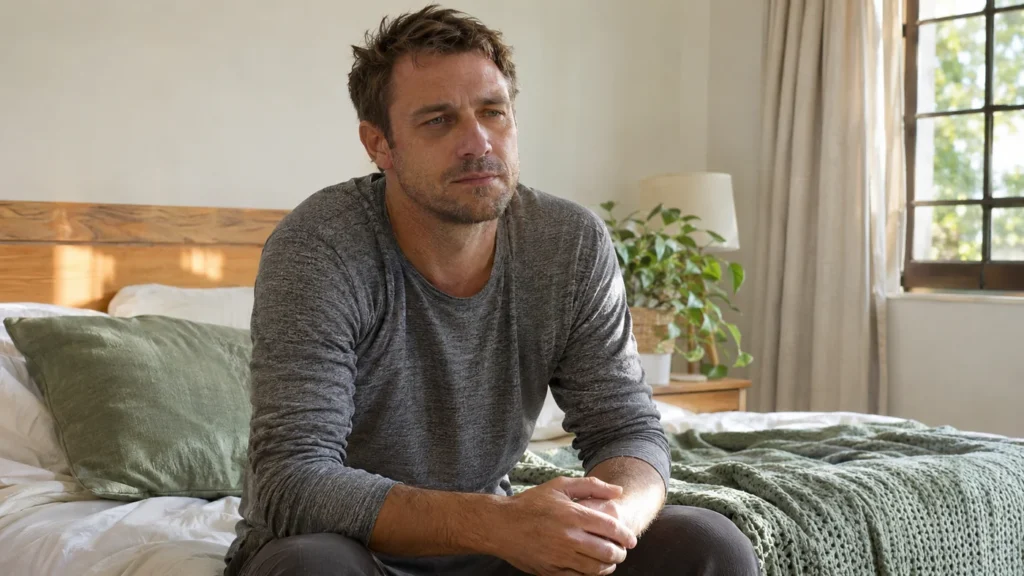
Insomnia in early recovery can be exhausting. Someone who used alcohol to fall asleep may now lie awake for hours. People recovering from cannabis or stimulant use may feel tired but unable to rest. The urge to use again just to sleep can be intense.
Sleep disruption in recovery has a recognisable trajectory. It usually improves with time, and specific clinical and behavioural strategies can help without relying on addictive sleep medication.
Why sleep falls apart in recovery
Several mechanisms operate at once.
The brain is recalibrating
The substances used during active addiction directly affect sleep architecture. Alcohol initially sedates but disrupts deep sleep and REM sleep over the night. Cannabis suppresses REM sleep. Stimulants delay sleep onset and shorten sleep. Opioids fragment sleep. Benzodiazepines reduce deep sleep over time.
When these substances are removed, the brain has to relearn how to produce normal sleep. This recalibration takes weeks to months. During this period, sleep is often poor.
Rebound
After substances are removed, the brain often overshoots in the opposite direction. The person who used to fall asleep instantly under alcohol now cannot fall asleep at all. The person who slept ten hours daily on cannabis now cannot manage four. This rebound effect is real and usually temporary.
Withdrawal-related hyperarousal
Withdrawal involves nervous system hyperarousal: increased heart rate, increased cortisol, increased anxiety. This is incompatible with sleep. The acute phase of withdrawal often involves significant insomnia.
Co-occurring conditions becoming visible
Anxiety, depression, PTSD, ADHD, and other conditions that were masked by substance use often become more visible in early recovery. Each of these affects sleep. The picture often clarifies as the substances clear.
Disrupted circadian rhythm
Active addiction often disrupts daily timing patterns. Sleep timing, mealtimes, exposure to daylight, and physical activity all get rearranged around use. The circadian system has to re-establish itself.
Anxiety about sleep
Once a few bad nights have occurred, a secondary anxiety develops: anxiety about not being able to sleep. This anxiety itself prevents sleep. The pattern becomes self-reinforcing.
The typical timeline
Sleep recovery is not linear, but there is a typical trajectory.
Acute phase (first 1-2 weeks)
Often the worst. Sleep is fragmented, brief, or absent. The brain has not yet begun recalibration in a meaningful way. This phase is best supported in residential treatment where it can be managed clinically.
Early recovery (weeks 2-8)
Gradual but uneven improvement. Some nights are better, some are worse. Sleep architecture is still abnormal. Vivid dreams are common (and sometimes uncomfortable). Sleep onset may be slow.
Stabilisation (months 2-6)
Sleep gradually approaches normal. Many people report substantial improvement by three months. Episodes of poor sleep still occur but are less frequent.
Long-term (6 months and beyond)
For most people, sleep is essentially normal by six months and continues to improve. Some specific patterns (vivid dreams, occasional disrupted nights) may persist longer.
For people with very long-standing heavy use, particularly of substances that profoundly disrupt sleep (benzodiazepines, alcohol over many years), normalisation may take longer.
What helps: the evidence-based approach
The single most effective intervention for chronic insomnia, including insomnia in recovery, is Cognitive Behavioural Therapy for Insomnia (CBT-I). It outperforms medication in long-term outcomes and is the recommended first-line treatment.
The core components of CBT-I:
Sleep restriction
Counterintuitively, the most powerful CBT-I technique is reducing the amount of time spent in bed to match the amount of sleep actually being obtained, then gradually expanding. This consolidates sleep and rebuilds the brain’s association between bed and sleep.
For someone getting four hours of sleep across an eight-hour time in bed, this might mean spending only five hours in bed initially, with strict timing, until sleep efficiency improves. As efficiency rises, the time in bed expands.
Stimulus control
The bed is for sleep and sex only. Not for working, watching, scrolling, or worrying. If sleep does not come within about 15 to 20 minutes, the person gets up and does something quiet elsewhere, returning to bed only when sleepy.
This rebuilds the bed-sleep association that has been disrupted.
Cognitive restructuring
The thoughts that maintain insomnia, “If I do not sleep I will not function tomorrow,” “I am going to be terrible at work,” “I will never sleep normally again”, are examined and tested against reality. The cognitive load contributes significantly to the inability to sleep.
Relaxation training
Specific relaxation techniques, often including progressive muscle relaxation, paced breathing, and mindfulness practices, support the physical relaxation needed for sleep.
Sleep hygiene
Important but on its own insufficient. The principles:
- Consistent timing. Same bedtime, same wake time, including weekends.
- Wind-down period. A predictable hour before bed without screens, work, or stimulating activity.
- No caffeine after early afternoon. Caffeine has a long half-life. The cup at 3pm may still be active at midnight.
- No alcohol to help sleep. This is critical in recovery and clinically important even for those not in recovery.
- No heavy meals close to bedtime.
- Cool, dark, quiet bedroom.
- Daily light exposure, ideally morning daylight.
- Daily physical activity, not in the late evening.
- No clock watching during the night.
Treatment of underlying conditions
Where anxiety, depression, PTSD, or other conditions are contributing to insomnia, these are treated in parallel. SSRIs (used for anxiety or depression) can help indirectly. Trauma-focused therapy where indicated. Mindfulness-based interventions.
What to avoid
Some responses can make sleep or recovery harder.
Alcohol or cannabis to sleep
The most dangerous category. The use of any substance to sleep in early recovery undermines the recovery itself and often progresses back to active addiction.
Benzodiazepines or z-drugs (including Stilnox)
These should not be used routinely for insomnia in someone with a history of substance use disorder. They are themselves addictive, and they may cross-react with the previous substance pattern. Where they are used at all in this population, it is in carefully limited, short-term, supervised circumstances.
Over-the-counter sleep aids
Some over-the-counter sleep aids contain antihistamines or other agents that can produce next-day cognitive impairment and that are not appropriate for routine use.
Sleep-catching behaviours
Long daytime naps, very early bedtimes, prolonged lying in bed awake, all of these undermine night-time sleep. Counterintuitive but consistent: better sleep at night often requires resisting the urge to compensate during the day.
Catastrophic thinking
The thought “I will never sleep again” is almost always wrong, and indulging it makes sleep harder. The accurate frame: recovery insomnia is real, is temporary for almost everyone, and is workable.
Medications that may help (carefully)
Some medications that are non-addictive may be used in specific clinical situations. These are individual clinical decisions made by your psychiatrist.
- Trazodone at low doses is sometimes used for insomnia and is not addictive.
- Mirtazapine has sedating properties and treats depression.
- Melatonin has modest effects on sleep onset for some people.
- Hydroxyzine is an antihistamine that may be used for short periods.
These are not routinely prescribed, and the underlying recovery and CBT-I work remain the primary approach.
Vivid dreams in early recovery
A particular feature of early recovery is the return of vivid dreaming, sometimes including dreams of using. These are not predictive of relapse. They are a sign that REM sleep is returning to normal (REM sleep is when most dreaming occurs, and substances suppress REM, so its return often produces a “rebound” of intense dreaming).
For people in trauma recovery, dreams may also include trauma material that was suppressed during active use. Where these dreams are distressing, trauma-focused therapy is part of the response.
When to get specific help
Most recovery insomnia resolves with time and with the strategies above. Some patterns warrant additional clinical input:
- Insomnia that has not improved by three months of recovery.
- Severe daytime impairment from sleep deprivation.
- Depression or anxiety symptoms that are not improving alongside the sleep issues.
- Distressing dreams that persist.
- Sleep apnoea symptoms (loud snoring, witnessed apnoea, severe daytime sleepiness) which require specific assessment.
- Suspicion of underlying sleep disorder that predates the substance use.
A note on sleep and relapse risk
Sleep deprivation is one of the most reliable triggers for relapse. The cognitive impairment, the emotional reactivity, and the cravings that develop with significant sleep deprivation can be powerful. This is why sleep is treated as a clinical priority in early recovery, not an inconvenience.
If you find your sleep deteriorating in recovery, it is worth a conversation with your aftercare clinician. This is exactly the kind of issue aftercare is set up to address.
FAQ: insomnia in recovery
How long will my sleep be bad? Most people see significant improvement by three months and substantial normalisation by six months. Some patterns persist longer in people with very long use histories.
Can I take Stilnox or Xanax to sleep in recovery? Generally no. These are addictive and undermine recovery. They may have limited supervised short-term use in specific clinical situations.
Is melatonin safe in recovery? Melatonin is generally safe and not addictive. Its effects are modest. It is sometimes used as part of a sleep plan in early recovery.
Should I exercise to sleep better? Yes, but not in the late evening. Morning or afternoon exercise has the strongest evidence for improving sleep.
Does CBT-I really work? Yes. The evidence is strong. It outperforms medication for long-term outcomes.
Does Anker Huis address sleep specifically in treatment? Yes. Sleep restoration is a core part of the residential and aftercare programmes.
If sleep has collapsed in recovery and the strategies you have tried are not working, our team can help. Call Anker Huis on +27 72 088 0446 or email info@ankerhuis.co.za to engage with your aftercare team.
Related Anker Huis support
Need confidential, professional support? Speak with Anker Huis about the right next step.